Sleep Safety & Materials
Baby Mattress Fit and Setup: A Guide to Organic Crib Mattresses
A baby’s sleep space is small, but the decisions behind it matter. The crib mattress should fit the crib securely, lie flat, and provide a firm surface. Organic materials may be important to a family, but a label alone cannot confirm that a mattress is compatible with a particular crib or appropriate for infant sleep. Careful measurement, a close reading of product instructions, and current safe-sleep guidance make a more useful starting point.
Published November 21, 2026
Begin with the crib–mattress pairing
A crib mattress is not a free-standing choice: it is one part of a system that includes the crib frame, support deck, mattress height settings, and fitted sheet. A mattress that seems close in size may still leave an unsafe space at an edge or fail to sit properly on the crib’s support. The goal is a snug, level fit with no noticeable gaps between the mattress and the crib sides.
Start by identifying the exact crib model and checking its manual or manufacturer’s instructions. Then confirm the mattress dimensions and any compatibility guidance on the mattress label. Standard full-size crib mattresses are generally designed around regulated dimensions, but products and crib interiors can vary. The printed size, a retailer’s category label, or the word “standard” should not replace checking the specific crib and mattress together.
When a mattress is in place, look carefully along every side and corner. It should rest flat on the support and remain stable rather than shifting freely. If an obvious gap appears, the mattress bows, or it does not sit securely, do not try to correct the mismatch with rolled towels, blankets, foam, or other improvised fillers. Contact the crib or mattress manufacturer for compatibility guidance and use a properly matched product.
Fit is not a comfort preference to be adjusted with extra padding. A baby needs a sleep surface that is firm and flat, with the mattress used as intended by its manufacturer. Softening a surface with a topper or cushion changes its characteristics and can introduce hazards. When in doubt, pause setup until the correct combination is confirmed.
What “organic” does—and does not—tell you
Organic crib mattresses may include cotton or other materials produced and processed under particular standards. Some products identify organic components and name certifications; others use broad phrases that leave the details unclear. Treat “organic” as a materials claim to investigate, not as a complete statement about safety, firmness, fit, or suitability for a given crib.
Read the label and product documentation for the mattress’s full construction. Check which layers are certified, who issued the certification, and whether it applies to the fiber, the finished product, or a particular manufacturing process. Certifications can help clarify sourcing or chemical-management criteria, but they do not automatically establish that a mattress is the right size for your crib or that its surface meets every requirement for infant sleep.
Construction matters, too. A mattress may contain cotton, latex, foam, wool, or combinations of materials. The material name alone does not determine how firm the complete sleep surface is, how it should be cleaned, or whether a cover can be removed. Follow the manufacturer’s instructions rather than assuming that natural or organic materials can be treated like ordinary household bedding.
It is also useful to separate environmental preferences from sleep-safety checks. Families may choose organic materials because of fiber sourcing, manufacturing standards, or personal values. Those considerations can inform a purchase, but they should come after the essentials: the mattress is intended for the crib, fits securely, is firm and flat, and is used according to its instructions.
A careful setup, step by step
Unpack and assemble the sleep space in a calm, well-lit area, using the crib and mattress instructions rather than relying on guesswork. Before placing the mattress, inspect the crib’s frame, support, and hardware. Make sure the support is attached as directed and that all required components are present. If the crib is secondhand, confirm its model, condition, and current safety status; do not use a crib with missing parts, damaged rails, or uncertain instructions.
- Confirm the products. Match the crib model and mattress details to their labels and manuals. Check whether the manufacturer specifies a compatible mattress size or type.
- Install the support correctly. Use the designated mattress support and follow the crib manual for its position and attachment. Do not substitute a board or other material unless the manufacturer specifically directs it.
- Place the mattress flat. Set it on the support in the orientation specified by the manufacturer. Check that it does not tilt, buckle, or sit unevenly.
- Inspect the perimeter. Look along all sides and corners for gaps or signs that the mattress is too small, too large, or incompatible. Seek manufacturer advice if the fit is not clearly secure.
- Use only a fitted sheet. Choose a sheet made for the mattress dimensions and designed to fit snugly. Check that it stays in place and does not bunch or come loose.
- Keep the sleep space clear. For sleep, leave out pillows, quilts, loose blankets, stuffed toys, positioners, and other soft objects. Follow current safe-sleep advice from recognized public-health authorities and your child’s clinician.
The familiar image of a nursery often includes layers of decorative bedding. For an infant’s sleep space, simplicity is intentional. A bare, properly fitted mattress with a fitted sheet is easier to inspect and avoids adding loose items around the baby.
Firmness, flatness, and the sleep surface
A mattress can feel comfortable to an adult and still be unsuitable for an infant. A baby sleep surface should be firm and flat, not soft, sagging, or inclined. Avoid using an adult mattress, a couch, a padded nest, or a makeshift surface in place of a crib mattress designed for that sleep space. A snug fit does not make an overly soft mattress appropriate, and a firm mattress does not compensate for an unsafe gap.
Do not add a topper to change the feel or height of a crib mattress. Do not place a pillow, folded blanket, or extra pad beneath or over the baby to improve comfort or “support.” These additions can change the surface and may create hazards. If a mattress appears damaged, has a soft or uneven area, or no longer lies flat, consult its manufacturer about whether it should be replaced.
Inclined sleep products and wedges should not be used to position a baby for routine sleep unless a qualified clinician gives specific advice for an individual medical situation. A baby who rolls, spits up, or seems uncomfortable still needs a safe sleep setup; caregivers should ask a pediatric health professional about concerns rather than altering the sleep surface on their own.
Safe sleep recommendations can be updated as evidence and standards evolve. Families should consult current guidance from the American Academy of Pediatrics, the U.S. Consumer Product Safety Commission, and their child’s health-care provider. This article is general educational information, not a substitute for medical advice or the instructions for a specific crib or mattress.
Covers, protectors, and bedding choices
A fitted sheet should match the mattress dimensions and remain secure during use. Avoid a sheet that is oversized, elastic that no longer holds, or fabric that can come loose and bunch. If a sheet’s fit is uncertain, compare its specifications with the mattress label and ask the manufacturer for guidance.
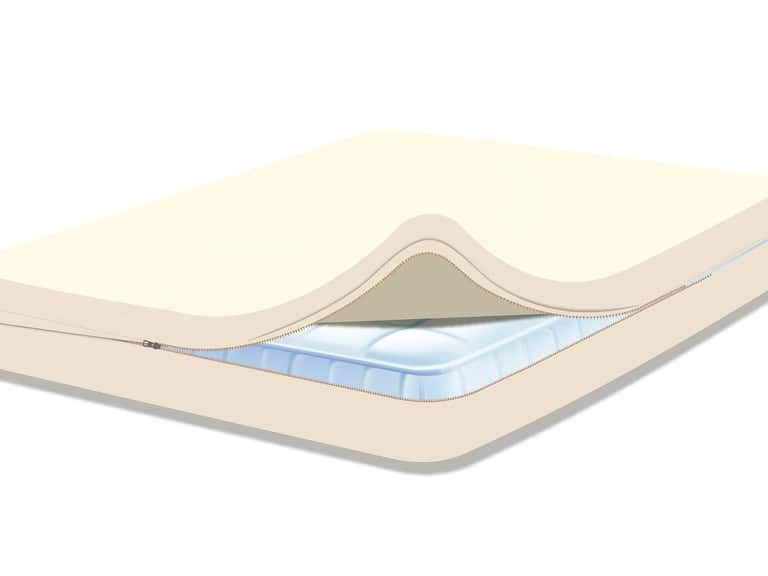
Families may also consider a mattress protector to guard against moisture or stains. For an infant’s sleep surface, the protector must be compatible with the specific mattress and used exactly as its manufacturer directs. It should not create a loose, padded, or uneven layer. If the product instructions are unclear, do not assume it is suitable simply because it is marketed for a crib or made from organic fabric.
A washable crib mattress pad, for example, is not automatically appropriate for every infant sleep setup. Additional layers can affect the surface, and product descriptions do not replace safe-sleep guidance. Check both the mattress and accessory instructions, and keep the sleep surface firm, flat, and free of loose bedding. Never use an accessory to fill a gap around the mattress.
Waterproofing and breathability are common marketing themes. They may describe a product’s material or intended function, but neither word by itself proves that an accessory is needed or suitable. Focus on the exact construction, fit, care directions, and any warnings. When a caregiver needs a way to manage frequent leaks or spills, a pediatric clinician can also help distinguish routine care questions from health concerns.
Care and inspection over time
Before the first use, follow the mattress label for unpacking, airing, cleaning, and any required waiting period. Some products arrive compressed or have specific handling directions. Do not wash a mattress or remove a cover unless the maker says that it is designed for that care. A cover that looks removable may still be an integral part of the mattress construction.
For routine care, use the manufacturer’s recommended method and cleaning products. Avoid soaking the mattress or applying unapproved sprays, solvents, or treatments. These can damage materials or leave residues. If a spill occurs, act promptly according to the product directions, then allow the surface to dry completely before returning it to use. Keep the crib area ventilated while cleaning and follow any instructions about safe handling of the mattress.
Inspect the mattress periodically, including when changing sheets. Look for torn seams, exposed filling, persistent dampness, unusual odors, sagging, or damage that changes the surface. Check that the fitted sheet still fits correctly and that the mattress remains securely positioned. As the child grows, adjust the crib mattress support only as directed in the crib manual; the support setting does not change the need for a firm, flat surface.
Replace a mattress if its manufacturer recommends replacement, if it is damaged, or if it no longer fits the crib securely. A hand-me-down can be useful only when its history and condition are known and it remains compatible with the crib. If age, storage conditions, or prior damage are uncertain, ask the manufacturer or a qualified child-safety resource before use.
A practical checklist for choosing an organic crib mattress
When comparing options, focus on information that can be verified rather than relying on broad claims. A short checklist helps keep the decision grounded:
- Does the manufacturer identify the mattress as intended for the relevant crib type?
- Do the stated dimensions match the crib’s instructions, and can the mattress be checked in the actual crib?
- Is the mattress firm, flat, and stable when correctly installed?
- Does the product label explain its materials and construction clearly?
- Are certification claims specific about the materials or processes covered?
- Are cleaning, drying, and cover-care instructions easy to find?
- Does the maker explain how to address fit questions, defects, or product concerns?
- Can the sleep setup be used without soft accessories or extra padding?
It can help to keep the crib and mattress manuals together, along with purchase information and care instructions. That record makes it easier to confirm the exact model if a question arises. It also prevents a common source of confusion: assuming that two mattresses labeled for the same general crib size are interchangeable without checking their actual fit and specifications.
Common assumptions worth revisiting
“Organic means safest.” Organic certification may describe how particular materials were produced or processed. It does not, by itself, establish fit, firmness, or compatibility. Verify those separately.
“A small gap can be filled.” Improvised fillers can create new problems rather than solve a mismatch. Use a mattress that fits the crib as intended and seek manufacturer guidance when fit is uncertain.
“More padding means more comfort.” Adult ideas about plushness do not apply to an infant sleep surface. Do not soften a crib mattress with a topper, quilt, pillow, or additional pad.
“A waterproof layer is always harmless.” An accessory should be considered only if it is compatible with the mattress and used according to its instructions. Its material or marketing description is not enough to establish suitability.
“Once it is set up, it no longer needs checking.” Sheets stretch, products wear, and a crib may be adjusted as a child grows. A quick periodic inspection helps catch loose bedding, damage, or a changed fit.
The quiet value of a simple setup
Choosing a baby mattress can lead through a thicket of fiber names, certifications, construction descriptions, and assurances about comfort. The most important checks are less complicated: match the mattress to the crib, confirm that it sits firmly and flat, use a snug fitted sheet, and keep the sleep area clear. Organic materials may be part of a family’s priorities, but they belong alongside—not in place of—those practical requirements.
When a product label, fit, or accessory raises questions, contact the manufacturer or consult a qualified child-safety or health professional. A measured, uncluttered sleep space does not promise perfect sleep, but it gives caregivers a clear and consistent foundation for following current safe-sleep advice.
Frequently asked questions
How do I know whether a crib mattress fits?
Check the crib and mattress instructions and labels, then inspect the mattress in the assembled crib. It should sit flat and securely, with no noticeable gaps around the edges. If the fit is uncertain, do not fill spaces with bedding; contact the manufacturers.
Does an organic crib mattress automatically meet safe-sleep needs?
No. The word “organic” concerns materials or production claims and does not by itself confirm fit, firmness, flatness, or compatibility. Evaluate those features independently and follow current safe-sleep guidance.
Can I use a mattress topper or extra pad for comfort?
Do not add a topper or improvised padding to soften or alter an infant’s sleep surface. Keep the mattress firm and flat, and use only bedding and accessories that are explicitly compatible and permitted by the relevant instructions and current guidance.
How often should I inspect the mattress?
Check it when setting up the crib and periodically while changing sheets. Look for damage, sagging, dampness, loose fabric, and a secure fit. Follow the manufacturer’s advice about care and replacement.